






China’s Tote Shuttle industry is moving from simple storage toward faster, denser, and more measurable fulfillment. China’s manufacturers now serve e-commerce, retail, pharmaceuticals, food, and industrial distribution. Their systems combine shuttle robots, lifts, conveyors, warehouse control software, and standardized totes.
The 2024 MHI Annual Industry Report, prepared with Deloitte, states that 55% of supply-chain leaders expect higher investment in technology and innovation. The same report shows growing confidence in automation over the next five years. Interact Analysis also identifies warehouse automation as a sustained growth market, driven by labor shortages, rising order volumes, and space limitations. These figures explain why Tote Shuttle solutions attract global buyers.
John Paxton, CEO of MHI, described the current period as “a time of transformation” for supply chains. His observation fits the factory floor. A tote moves quietly through steel channels, pauses at a lift, and reaches a picking station within seconds. Small details matter.
However, headline throughput is not enough. A system may promise 1,000 totes per hour, yet poor software integration can create delays. Energy use, maintenance access, tote quality, and seasonal peaks also deserve careful review. This is where Chinese suppliers can show practical experience, not merely attractive specifications.
This guide examines China’s leading Tote Shuttle manufacturers and suppliers. It considers system design, customization, software compatibility, production capability, after-sales support, and export experience. The market is impressive, but buyers should remain cautious. The best solution is rarely the most dramatic one. It is the system that performs reliably during an ordinary, demanding working day.
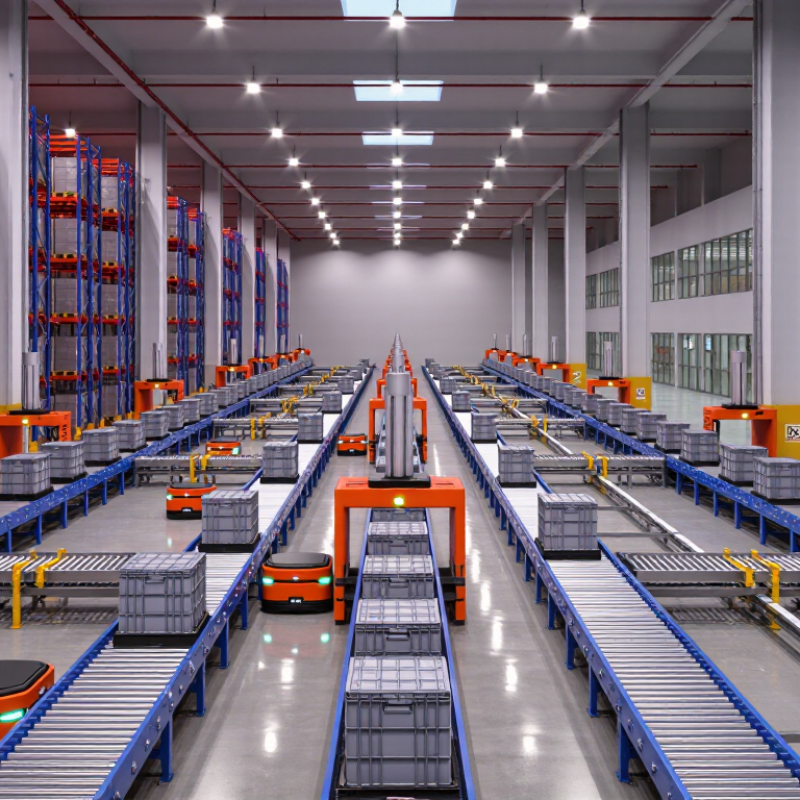
Tote shuttle systems are automated storage and retrieval solutions designed for plastic totes, cartons, and small containers. A typical system includes steel racks, shuttle cars, lifts, conveyors, sensors, and warehouse control software. The shuttle moves horizontally inside a storage lane, while lifts transfer totes between levels. Conveyors then connect storage with picking or packing stations.
The operating cycle is precise but not complicated. A software command identifies an available tote and storage position. The lift reaches the correct level, and the shuttle retrieves or places the container. Sensors check tote position, load stability, and lane access. This reduces walking and supports dense storage. MHI’s 2023 Annual Industry Report found that 83% of supply chain leaders expected technology investment to increase over the next five years. That trend supports wider interest in shuttle-based automation.
Capacity depends on tote size, rack height, shuttle speed, lift spacing, and order patterns. Interact Analysis has reported strong growth in warehouse automation demand, driven by labor shortages and e-commerce fulfillment requirements. Yet system design is not automatically efficient. Poor slotting can create lift congestion, even when storage density looks impressive. Maintenance access also needs honest planning. One blocked conveyor may affect several zones. Experienced suppliers should test peak-hour traffic, not only average throughput, before recommending equipment.
| Category | Parameter | Definition, Structure, or Operating Principle |
|---|---|---|
| System Definition | Tote shuttle system | An automated storage and retrieval system designed to store, move, and retrieve plastic totes or cartons. A rail-guided shuttle travels inside storage channels, while lifts and conveyors transfer totes between storage levels and workstations. |
| Primary Application | Typical use cases | Commonly used for order picking, goods-to-person fulfillment, spare-parts storage, e-commerce operations, pharmaceutical distribution, electronics logistics, and high-density inventory buffering. |
| Load Unit | Common tote formats | Frequently used tote footprints include approximately 600 × 400 mm and 400 × 300 mm. The final tote size depends on product dimensions, storage-channel design, conveyor interfaces, and required load capacity. |
| Load Unit | Typical tote payload | Many systems are engineered for tote loads of approximately 20–50 kg. The permitted payload must be confirmed from the shuttle, rack, lift, conveyor, and tote specifications as a complete system. |
| Storage Structure | Rack frame | A steel rack structure supports multiple storage levels and channels. Each channel normally contains guide rails, tote supports, position sensors, and mechanical clearances for shuttle movement. |
| Storage Structure | Storage channels | Totes are arranged in lanes or channels. Depending on the layout, a channel may use single-depth or multi-depth storage, with the shuttle positioning totes to maintain access and inventory density. |
| Shuttle Equipment | Rail-guided shuttle | The shuttle is a motorized carrier that runs on rails within a rack channel. It normally includes drive wheels, tote-support mechanisms, sensors, a control unit, and a rechargeable or contact-based power system. |
| Shuttle Equipment | Tote handling mechanism | A belt, roller, chain, telescopic, or friction-based mechanism moves the tote between the shuttle and the rack position. The mechanism is selected according to tote bottom design, payload, speed, and positioning accuracy. |
| Vertical Transfer | Lift or vertical conveyor | A lift transfers totes between rack levels and the input or output conveyor. It may serve several levels and is coordinated with shuttle dispatching, tote identification, and workstation demand. |
| Material Flow | Inbound sequence | An empty or loaded tote arrives at the induction conveyor, where its identification and dimensions may be checked. The control system assigns a storage location, and the lift and shuttle transport the tote to that position. |
| Material Flow | Storage sequence | The shuttle receives the tote from the lift or transfer point, travels to the assigned channel location, places the tote on the rack supports, confirms the position with sensors, and reports the completed task to the control system. |
| Material Flow | Retrieval sequence | When an order is released, the control system identifies the tote location. The shuttle collects the tote, delivers it to the lift or transfer point, and the conveyor routes it to the designated picking, packing, or dispatch station. |
| Control System | Warehouse control | Warehouse management or warehouse control software manages inventory records, task priorities, storage locations, tote destinations, equipment status, and communication with enterprise or order-management systems. |
| Identification | Tote tracking | Barcode labels, two-dimensional codes, RFID tags, or sensor-based position confirmation can be used to identify totes and verify that the correct load is at the correct location. |
| Performance | Throughput | Throughput is normally measured in tote movements or cycles per hour. Actual performance depends on travel distance, lift speed, tote weight, storage height, replenishment pattern, order profile, and the number of shuttles and lifts. |
| Performance | Storage density | The system can provide high cubic storage density by using narrow aisles, closely spaced levels, and multi-depth channels. Density is determined by usable building height, fire regulations, tote dimensions, access requirements, and rack geometry. |
| Performance | Travel and positioning | Shuttle travel speed and positioning accuracy are selected according to payload and operating cycle requirements. Acceleration, deceleration, tote stability, and sensor feedback are important for reliable high-frequency operation. |
| Power System | Energy supply | Shuttles may use rechargeable battery packs, conductive charging rails, or other engineered power-transfer methods. Charging or energy replenishment can be scheduled during low-demand periods or integrated into normal operating cycles. |
| Safety | Protection features | Typical safety provisions include emergency-stop circuits, guarded access points, collision detection, overload monitoring, position sensors, protective fencing, interlocked doors, and controlled recovery procedures. |
| System Integration | Connection with conveyors | Conveyors connect receiving, storage, picking, packing, and shipping areas. Transfer points require compatible tote dimensions, controlled spacing, accumulation logic, and reliable handshaking between adjacent equipment. |
| System Integration | Goods-to-person operation | Instead of requiring operators to walk through storage aisles, the system automatically delivers required totes to ergonomic picking stations. This can reduce travel time and improve picking consistency. |
| Maintenance | Routine maintenance items | Regular checks generally include rails, drive wheels, belts or chains, sensors, batteries or charging contacts, lift mechanisms, conveyor rollers, rack connections, emergency devices, and software alarms. |
| Design Selection | Key planning inputs | Important design inputs include SKU count, inventory quantity, tote dimensions, maximum payload, daily order volume, peak hourly demand, required storage time, building height, temperature, fire protection, and future expansion requirements. |
| Advantages | Operational benefits | Main benefits can include improved space utilization, reduced manual travel, consistent inventory tracking, scalable throughput, controlled access to goods, improved ergonomics, and the ability to operate with fewer manual storage activities. |
| Limitations | Engineering considerations | The system requires accurate tote dimensions, stable loads, clean rails and conveyors, reliable controls, planned maintenance, and suitable building conditions. Irregular products or unstable loads may require special containers or handling devices. |
